
I. Introduction
When you buy car tyres, brand is often the first thing that comes to mind. The tyre market is mature, with products standardized and performance indicators required by law to be marked on the tyre sidewall. The logic for choosing PCR tire should be: on the premise that tyre size matches the original, read and evaluate three performance parameters – load index, speed rating, and treadwear. Ignoring these parameters and focusing only on brand may lead to poor choices. This article breaks down these three parameters.
Prerequisite: When replacing tyres, the size of new tyres (e.g., 215/55 R16) must match the original; otherwise, vehicle performance and annual inspection will be affected.
II. Key Parameters for Car Tire Replacement: Load Index
The load index is a quantitative measure of a tyre’s load capacity and is directly related to driving safety.
The number in markings like “93H” or “104W” (93, 104) is the load index, corresponding to the maximum load capacity of a single tyre under standard inflation pressure. Example: index 93 corresponds to 650 kg, index 104 corresponds to 900 kg.
Tire Load Index Comparison Table
| Load Index | Max Load Capacity (kg) | Load Index | Max Load Capacity (kg) | Load Index | Max Load Capacity (kg) |
|---|---|---|---|---|---|
| 80 | 450 | 91 | 615 | 100 | 800 |
| 85 | 515 | 93 | 650 | 101 | 825 |
| 87 | 545 | 96 | 710 | 103 | 875 |
| 88 | 560 | 97 | 730 | 105 | 925 |
| 90 | 600 | 99 | 775 | 108 | 1000 |
III. Tyre Speed Rating: Match Your Driving Scenario
The speed rating determines the maximum speed a tyre can safely withstand and should be matched to your driving scenario.
The letter in markings like “93H” or “104W” (H, W) is the speed rating. Example: H corresponds to 210 km/h, W corresponds to 270 km/h.
When driving on paved roads and complying with legal speed limits (max 120 km/h), H-rated tyres meet daily needs. You can choose based on your vehicle’s maximum speed shown on the speedometer.
Tire speed symbols list
| Speed Rating | Max Speed (km/h) | Speed Rating | Max Speed (km/h) |
|---|---|---|---|
| A1 | 5 | K | 110 |
| A2 | 10 | L | 120 |
| A3 | 15 | M | 130 |
| A4 | 20 | N | 140 |
| A5 | 25 | P | 150 |
| A6 | 30 | Q | 160 |
| A7 | 35 | R | 170 |
| A8 | 40 | S | 180 |
| B | 50 | T | 190 |
| C | 60 | U | 200 |
| D | 70 | H | 210 |
| E | 75 | V | 240 |
| F | 80 | W | 270 |
| G | 90 | Y | 300 |
| J | 100 | ZR | >240 |
During emergency braking, vehicle inertia transfers most of the weight (about 80%-90%) to the two front tyres, which must bear a load close to or exceeding the vehicle’s total weight. The original tyre load design includes a safety margin: the load capacity of two front tyres roughly equals the vehicle’s total weight. When replacing tyres, you must choose tyres with a load index equal to or higher than the original. This is the most critical rule every time you buy car tyres for your family vehicle.
IV. Tyre Treadwear Rating: Balancing Grip and Lifespan
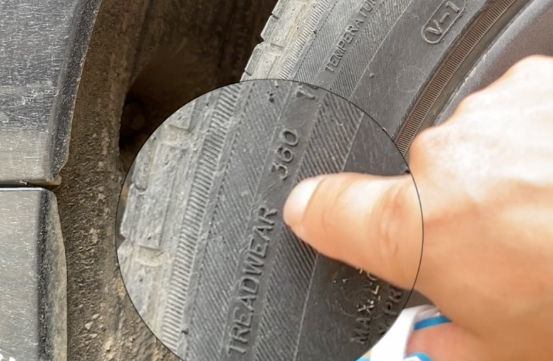
The treadwear rating represents the trade-off between tyre lifespan and dry road grip. The number following “TREADWEAR” on the tyre sidewall is the treadwear rating: higher numbers mean longer wear life, lower numbers mean faster wear.

For lighter vehicles (e.g., 1.3-ton sedan), you may choose lower treadwear-rated tyres (e.g., 360) to gain better braking performance while maintaining reasonable lifespan. For heavier vehicles (e.g., 2-ton SUV), if braking safety is a priority, consider switching to lower treadwear-rated passenger car tyre. For example, a 2-ton vehicle switching to 360-rated tyres may see braking distance reduced by 15%, but the replacement cycle may shorten to one year. Conversely, a small car switching to 500-rated tyres may last 150,000 km, but braking distance may increase by 20%.
Therefore, general family vehicles should strike a balance between treadwear rating and grip, prioritizing safety over extreme durability. When shopping for new car tires, many drivers overlook this trade-off. Remember that a tyre that lasts longer does not necessarily stop shorter. The right choice depends on your vehicle weight and how you drive.
V. Forlander Tyre Brand
Forlander was founded in 2011, with headquarters and factory in Shandong, China. It has an annual production capacity of 3.6 million all-steel radial truck tyres and 2 million off-the-road (OTR) tyres, exporting to over 100 countries.
Forlander Tire Core Advantages
High value for money: Competitive pricing suitable for budget-conscious family car owners
Complete product line: Offers all-season tyres, high-performance tyres, and winter tyres, covering 15-22 inch wheel sizes, fitting most sedans and SUVs
Balanced performance: Combines comfort, low noise, high mileage, fuel efficiency, and wet traction
Certified quality: Products hold DOT, ECE, CCC and other international quality certifications
If you want balanced performance at a reasonable price, Forlander is worth considering.
VI. Summary
When you buy car tyres for your family vehicle, follow these steps: First, confirm the new tyre size matches the original. Second, keep the load index no lower than the original specification. Third, match the speed rating – choose a rating aligned with your vehicle’s top speed for regular driving; select a higher rating if you drive on low-traction surfaces (e.g., sand dunes). Fourth, prioritize braking performance over extreme tyre life. Fifth, once the above parameters are satisfied, consider value-oriented brands such as Forlander.
Whether you are selecting new car tires for the first time or replacing a worn set, understanding load index, speed rating, and treadwear will lead you to a safer and smarter purchase.