
I. Introduction
For ports and terminals, tires are the second largest operating cost after energy, yet they are often overlooked. They directly impact equipment reliability, safety, fuel consumption, and emissions. Facing diverse port equipment tires — from empty container handlers and reach stackers to RTGs and straddle carriers — along with extreme loads, low speeds, sharp turns, and abrasive surfaces, correct port tire selection and tire maintenance are essential for cost control and operational safety.
This article provides a clear framework on major tire types, equipment-specific challenges, common tire problems, and key precautions to help buyers make informed decisions. Understanding these common tire problems is the first step toward extending the life of tire maintenance programs and reducing total operating costs.
II. Key Port Equipment and Their Specific Tire Challenges
1. Empty Container Handlers: High 15-17m masts create extreme front-axle loads. High-speed sharp turns cause sidewall “kissing” between dual front tires, risking sudden failure.

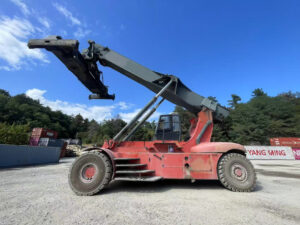
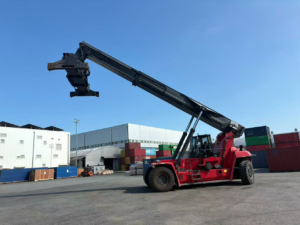
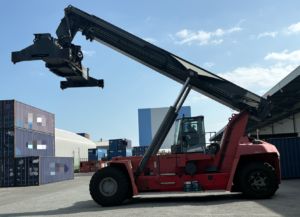
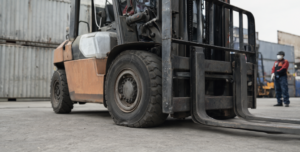
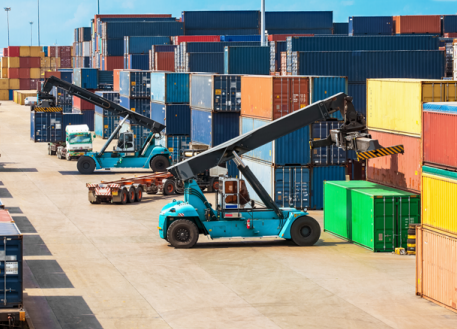
2. Heavy Forklifts & Reach Stackers: Reach stackers weigh 70-80 tonnes unladen, lifting loads up to 12m. Sidewall stiffness and stability against tipping are critical. Proper tire maintenance on these machines prevents premature wear.

3. Mobile Harbour Cranes (MHCs): Unladen weight up to 600 tonnes during moves. Long static periods cause UV degradation and flat-spotting, leading to premature failure.

4. Rubber-Tyred Gantry Cranes (RTGs): Must turn 90° on the spot under load. Lack of movement causes UV damage and flat spots; wear accelerates exponentially when moved. Selecting the right port tire for RTGs is crucial.

5. Straddle Carriers: Up to 70 tonnes unladen, speeds of 30kph with loads at 25m height. Hard braking triggers “slip-stick” effect, causing loss of surface contact and risk of tipping. Proper stiffness and damping are crucial.

6. Terminal Tractors: Highest mileage with frequent acceleration, braking, and cornering. Using road tires instead of specialty port equipment tires leads to higher failure rates.

7. Automated Guided Vehicles (AGVs): Heavy batteries add load. No human driver means the vehicle cannot avoid foreign objects — puncture and cut resistance are paramount.

III. Major Tire Types and Selection Criteria
A. Four Main Tire Types for Ports
Radial Tires: Comfortable, low rolling resistance, energy-efficient. Suitable for terminal tractors but lack durability for heavy port operations.
Crossply (Bias) Tires: The most common type in ports. High stability, excellent sidewall stiffness, and good aging resistance. Ideal for reach stackers, empty container handlers, and straddle carriers. Regular tire maintenance extends their already long service life.
Solid / Super-Elastic Tires: Puncture-free and maintenance-free. Long lifetime with good damping on rough terrain.
Treadless Tires: Very good wear and lower rolling resistance. Some operators prefer them to maximize surface contact.
B. Key Selection Criteria
Selection must balance multiple properties: load capacity, stability and lateral force resistance, cut/puncture durability, rolling resistance (accounts for ~20% of energy consumption), comfort/shock absorption, environmental resistance (UV, ozone, salt air), and retreadability for lower life-cycle cost. A well-chosen port tire can significantly improve the life of tire maintenance intervals.
IV. Main Causes of Tire Damage and Critical Maintenance Precautions
A. Common Tire Problems and Their Major Causes
The most frequent common tire problems in port operations include:
Under-inflation – the most common culprit. At 70% of recommended pressure, tire life is cut by more than half. This is a primary common tire problems example that proper tire maintenance can easily prevent.
Overload and wrong application – e.g., using road tires on terminal tractors instead of dedicated port equipment tires.
Foreign impacts and cuts – stones, debris, kerbs.
Fitting errors – improper bead seating, mixed rim components.
Aging – from UV, ozone, or chemicals.
B. Critical Tire Maintenance Precautions
To avoid these common tire problems, follow these tire maintenance rules:
Inflation pressure – Check cold tires every two weeks. Never adjust pressure on warm tires. Install TPMS for real-time monitoring. This single practice doubles the life of tire maintenance effectiveness.
Visual inspection – Check tread, sidewall, between duals, and rim flange for cuts, bulges, trapped stones, rust, or deformation.
Safety rules – Fully deflate before removing any wheel. Use a safety cage for multi-piece rims. Never weld cracked rims. Never mix radial and crossply on the same axle.
Repair & prevention – Repair punctures immediately. Have any tire with bulges or impact damage inspected by a specialist. Keep sites clean to reduce debris. Using quality port equipment tires also reduces these risks.
V. Forlander Port Tire Product Recommendations
Based on Forlander’s official product line and verified field performance, the following tire recommendations address specific operational issues such as flat-spotting, irregular wear, and cut damage. Proper care further enhances performance and extends service life.

This tread pattern is designed for Rubber-Tyred Gantry Cranes (RTGs) and Mobile Harbour Cranes (MHCs). Available models include:
21.00-35 – Tread depth 43.5mm. Load capacity: 43,700kg at 0km/h, 35,200kg at 5km/h, 33,800kg at 10km/h.
21.00-25 – Tread depth 43.5mm. Load capacity: 38,900kg at 0km/h, 31,100kg at 5km/h, 21,800kg at 10km/h.

This pattern is designed for Reach Stackers. Available models include:
- 18.00-25 JU911 – Proven performance in Busan, South Korea. Achieved approximately 2,800 working hours on a Kalmar reach stacker (steering axle) with no abnormal failure, no irregular wear, and stable handling on brick-paved surfaces.

This pattern is designed for Reach Stackers. Available models include:
- 18.00-25 JU910 – Tested in Laem Chabang, Thailand on a SANY reach stacker. Front axle service life reached 1,650 hours; rear axle 1,300 hours with no irregular wear or other quality issues.
4. F538-S Tread Pattern (Heavy Forklift Series)

This pattern is designed for Heavy Forklifts. Available models include:
14.00-24 – Available in TT or TL (tubeless), tread depth 43mm. Load capacity: 18,000kg at 0km/h, 14,500kg at 5km/h, 13,500kg at 10km/h.
12.00-24 – Suitable for heavy forklift operations in port and terminal yards.
12.00-20 – Compact option for smaller industrial forklifts.
VI. Conclusion
Port tire selection and maintenance directly impact safety, cost, and efficiency. Four pillars lower life-cycle costs: choose the right tire type, strictly manage inflation pressure with TPMS and bi-weekly cold checks, enforce safe procedures, and select tires for specific pain points. Integrate tire management into preventive maintenance. Choose a proven specialist like Forlander to achieve safe, green, and efficient terminal operations.